Fear Not!365 Days a Year
Learn How To Overcome Fear

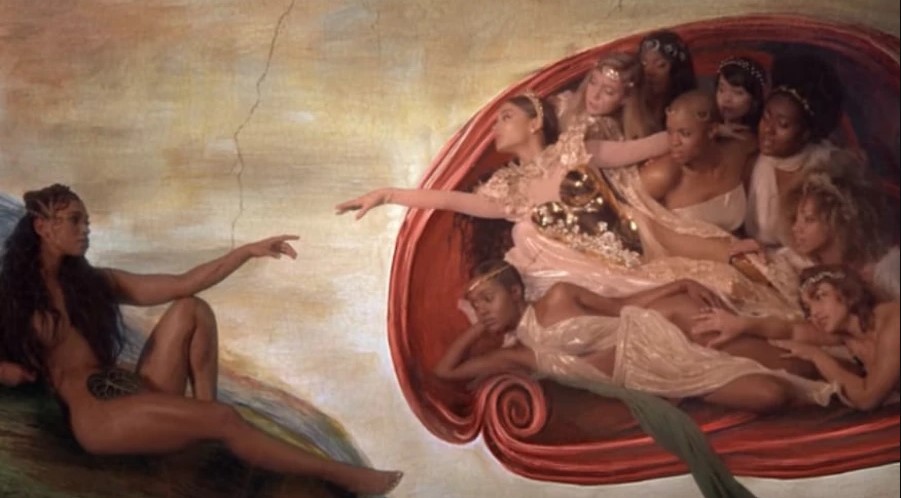
It is probably not accurate to view God as a woman, though the Bible does show God's feminine side, so to speak.
Modern Bible translators wrestle with the question of what is more appropriate or correct. Is it prejudiced to always refer to God as "him," which is the traditional approach? Is God even male or female? Or is God something else entirely?
However, in Genesis chapter 1 we are told that man (mankind; as opposed to "a man") is created in the image of God, both male and female...
Most ancient people worshipped a host of gods and goddesses who influenced nearly every aspect of society. One of the earliest known works of literature is The Epic of Gilgamesh, which recounts one person's interactions with both male and female gods in his pursuit of immortality.1 Among many others described are the female goddess Ishtar and the male god Shamash.
In other words, the earliest known theological works suggest that gods were male or female.2
It wasn't until around 2000 BCE, when a new people emerged, that God began to be described in singular and masculine terms. These new people were known as the Hebrews and were later called Jews.
Peter Kreeft suggests, "The Jewish revelation was distinctive in its exclusively masculine pronoun because it was distinctive in its theology of the divine transcendence."3 This idea was so radical that these Hebrew adherents were undoubtedly considered by their neighbors to be an unusual bunch. But that seemed to be part of the plan for this new group—to be different and set apart.4
Following the rise of Jewish monotheism, most Christians and Muslims have similarly referred to the singular and sovereign God in decidedly masculine terms.5
Why, with the rise of the three monotheistic religions, did God become described exclusively as a man? Does this imply a belief that God has male sexual organs? Or is something else going on?
Most people would agree that God, by definition, is beyond physical reality. God is transcendent, meaning God exists outside of space and time.6 And if that is the case, then God cannot have physical body parts the way humans do.7 Therefore God is neither male nor female.
So why did the authors of the Bible and other sacred monotheistic literature pick the masculine pronoun to describe God? It could be that the cultures in which God was first described as the one true God were primarily patriarchal, meaning the males were, for the most part, the dominant sex.8
It could also be that in language, the male pronoun is often used to refer to any unknown gender. Or it could be that some other principle is at work.9
What the Bible explicitly reveals is that humanity—both males and females—was created in God's image.10 Now, if God were strictly a man as we perceive men, it would be quite difficult to create a woman in his image. We also know that God exhibits both masculine and feminine characteristics,11 and that the Scriptures use both male and female metaphors to describe him.12
Therefore, we should not be surprised if God has both a "maleness" and "femaleness" to Him, so both men and women can relate to God. God could be considered as motherly "hen" (Matthew 23:37) and yet be called the Heavenly Father (which is what Scripture often calls Him). God is both caring and nurturing, yet powerful and strong.
So why have we used the masculine pronoun when referring to God? As stated above, "The Scriptures use both male and female metaphors to describe her"?
Even C. S. Lewis, one of the greatest modern Christian thinkers, conceded this point, saying: "Why not? Since God is in fact not a biological being and has no sex, what can it matter whether we say He or She, Father or Mother, Son or Daughter?"13
Yet Lewis doesn't let us off the hook so easily. He concludes by saying, "Christians think that God Himself has taught us how to speak of Him. To say that it does not matter is to say either that all the masculine imagery is not inspired, is merely human in origin, or else that, though inspired, it is quite arbitrary and unessential. And this is surely intolerable."
In other words, while it might be anatomically imprecise to describe God as a male, it is equally misleading and arrogant to insist that we know better.
For the most part, God has chosen to reveal Himself in the Bible as having a male personage. The Bible is inspired of God (2Timothy 3:16), and in it God is always referred to as a "Him" or a "He." So God wanted people to understand Him as a "Him" and a "He."
Of course, God is so far beyond us, that He is certainly not a man or a woman. Though we are made in His image, and reflect some of who God is, we as humans certainly don't represent all that God is. Even if an artist were to paint a self-portrait, the artist himself is far more than his art.
In the end, the best we can do is trust that one day we'll meet God "face to face," when this question will be, once and for all, put to rest.
What is remarkable is that God has condescended to reveal himself to us. God became a man, in the person of Jesus Christ and desires to draw us into a relationship with him, which he made possible. To find out more, please see: Knowing God Personally.
1. To be precise, Gilgamesh himself was part god and part man. In the end he discovers that "The life that you seek you never will find: when the gods created mankind, death they dispensed to mankind, life they kept for themselves." Andrew George, trans., The Epic of Gilgamesh (New York: Penguin Classics, 2003), 124.
2. The Epic of Gilgamesh is only one example. The majority of other cultures—Egyptian, Greek, Roman, etc.—also worshipped a pantheon of gods and goddesses of both genders.
3. Peter Kreeft and Ronald K. Tacelli, Handbook of Christian Apologetics (Downers Grove, IL: InterVarsity Press, 1994), 98.
4. "The Lord had said to Abram, 'Go from your country, your people and your father's household to the land I will show you. I will make you into a great nation, and I will bless you; I will make your name great, and you will be a blessing.'" The Holy Bible, New International Version © 2011, Genesis 12:1–3.
5. Of course, there are notable exceptions in the field of feminist theology, where authors are publishing works with titles such as When God Was a Woman by Merlin Stone, What Became of God the Mother? by Elaine Pagels, and After the Death of God the Father" by Mary Daly.
6. Christian theology would suggest that though God is transcendent, he is also immanent. This means that though he is beyond human experience, he is also paradoxically intimately present in our reality.
7. God, being an eternal spirit, does not have a body. See The Holy Bible, John 4:24, 1 Timothy 1:17, and Revelation 1:8.
8. In most ancient literature, for example, crowds were described by counting the number of males present. In many cultures, men simply had more rights than women. Yet to allow cultural mores or grammatical trends to dictate theological truths is unwise.
9. Namely, God reveals himself in relational terms. All our relations are with either masculine or feminine beings, so we deal with them in these terms. The images used to describe God (king, warrior, father, etc.) are primarily masculine. Therefore, we tend to view God in masculine terms. In reality God is beyond male and female and is something else entirely. Language is limited in how it can express these realities.
10. "So God created mankind in his own image, in the image of God he created them; male and female he created them." The Holy Bible, Genesis 1:27.
11. He is loving and fierce, tender and just. See The Holy Bible, see Psalm 62:11-12.
12. See The Holy Bible, New International Version © 2011, Psalm 131:2 and Isaiah 42:14, 46:3, and 49:15. However, it must be stated that the Bible uses many more male metaphors than female metaphors to describe God.
13. C. S. Lewis, God in the Dock: Essays on Theology and Ethics (Grand Rapids, MI: Eerdmans, 1970), 237.

GotQuestions.org is a ministry of dedicated and trained servants who have a desire to assist others in their understanding of God, Scripture, salvation, and other spiritual topics. We are Christian, Protestant, evangelical, theologically conservative, and non-denominational. We view ourselves as a para-church ministry, coming alongside the church to help people find answers to their spiritually related questions.
We will do our best to prayerfully and thoroughly research your question and answer it in a biblically based manner. It is not our purpose to make you agree with us, but rather to point you to what the Bible says concerning your question. You can be assured that your question will be answered by a trained and dedicated Christian who loves the Lord and desires to assist you in your walk with Him. Our writing staff includes pastors, youth pastors, missionaries, biblical counselors, Bible/Christian college students, seminary students, and lay students of God's Word.


